
Sessions & Schedule
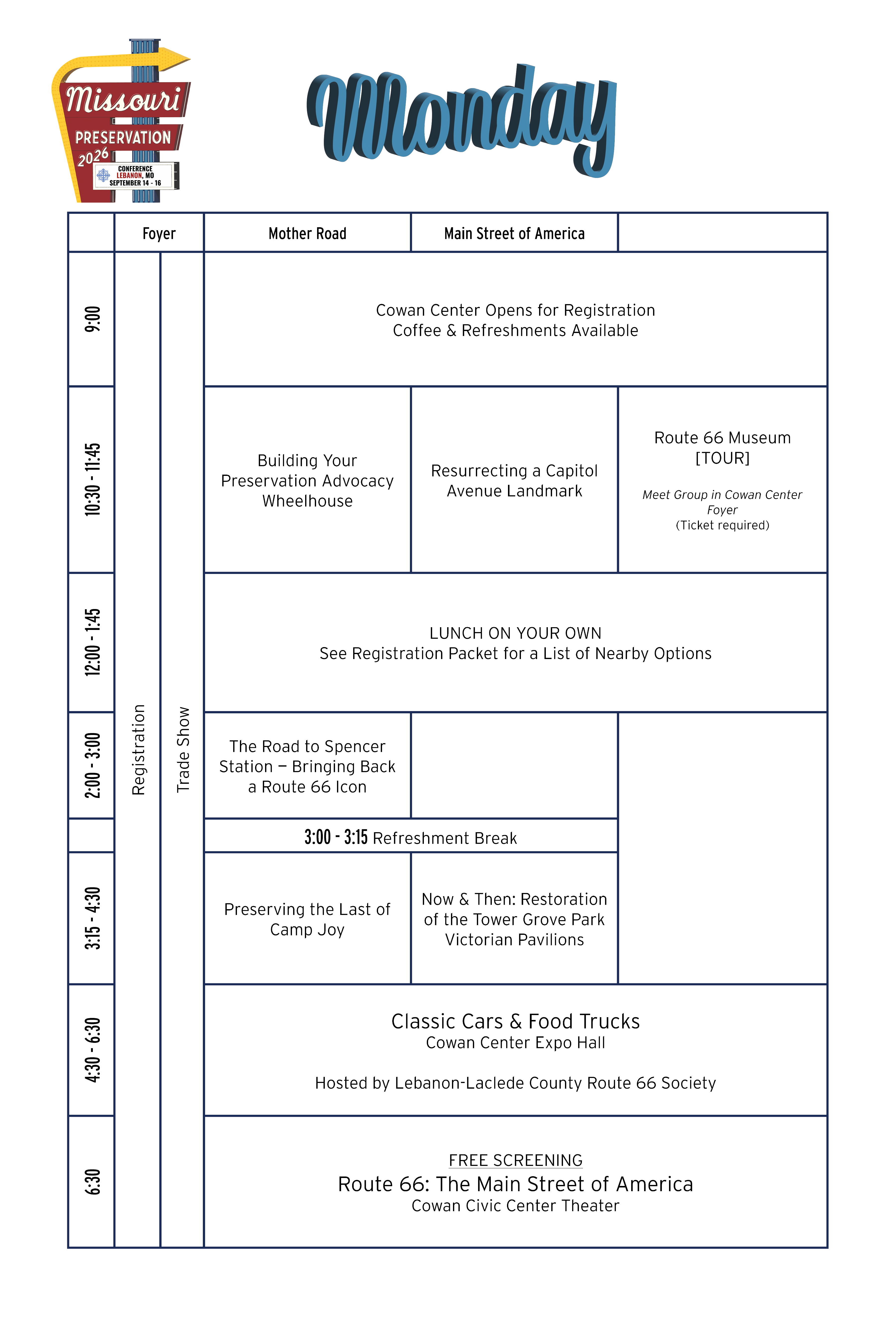
Monday, September 14th
Building Your Preservation Advocacy Wheelhouse
10:30 – 11:45 a.m. | 1.25 AIA LU
Want to get people on board with supporting historic preservation, but don’t know where to begin? Join Missouri Preservation’s Executive Director, Riley Price, as she walks through some of the key things to know on your journey as a supporter of historic preservation. From knowing what advocacy is and isn’t, to identifying treatments, battling misconceptions, and summarizing arguments as to why support preservation in the first place. This is a refreshed look at Preservation 101 that aims to cut back on the technical and give you what you need to start getting people on board as supporters of saving our historic built environment!
Riley Price, Executive Director — Missouri Preservation
Riley Price is the Executive Director of The Missouri Alliance for Historic Preservation (Missouri Preservation), Missouri’s only statewide non-profit dedicated to advocating for, educating about, and assisting with the preservation of the Show-Me state’s architectural heritage. Riley started at Missouri Preservation in 2017 as Administrator and became the organization’s Executive Director and only employee when they needed to downsize during the pandemic. From planning of programs and events, managing the day-to-day activities of the organization, editing the website, answering your questions — Riley does it all. Prior to working for Missouri Preservation, she interned at Downtown Washington, Inc. and spent her summers during college as a Seasonal Interpreter for Missouri State Parks. She graduated from Southeast Missouri State University in 2016 with a Bachelor of Science Degree in Historic Preservation. In love with historic buildings since a very young age, Riley hopes to one day put her knowledge to use and rehabilitate a historic home of her own (preferably one with an old, colorfully-tiled bathroom!)
Resurrecting a Capitol Avenue Landmark
10:30 – 11:45 a.m. | 1.25 AIA HSW
In 2025, the Missouri Association of Counties acquired the renowned Buescher Memorial Funeral Home, located on East Capitol Avenue in Jefferson City, Missouri. The organization secured the property from the City of Jefferson with the intent to rehabilitate the historic structure as its new headquarters. The design approach prioritized preservation of the building’s significant historic character while thoughtfully integrating modern office, meeting, and training functions. After decades of neglect, the property presented substantial challenges, including multiple tons of refuse, abandoned vehicles, and even human remains discovered on site. Faced with these extraordinary conditions, the design team first sought to establish a clear understanding of the structure’s history, condition, and potential. Through the use of advanced digital representation and documentation techniques, the team developed programming concepts and visualizations that allowed stakeholders to better understand the opportunities presented by the 150-year-old landmark. Participants will explore the history and transformation of this unique project while learning how the design team employed innovative diagramming, visualization, and presentation methods to communicate ideas, guide decision-making, and reimagine the future of a once-neglected historic property.
Paden Chambers, Project Manager — N-Form Architecture
pchambers@nformarc.com
A native of St. Joseph, Paden L. Chambers earned both his Master of Architecture and Bachelor of Art History degrees from the Drury University Hammons School of Architecture in 2014. He currently serves as a Project Manager at N·FORM Architecture, a design-focused firm located on historic Commercial Street in Springfield, where he oversees historic preservation projects with an emphasis on architectural research and sensitive additions to historic structures. Paden has served on numerous neighborhood planning and design committees for the City of Springfield and was a member of the Landmarks Board from 2014 to 2021. During his tenure, he helped oversee the revision of the Commercial Street Design Guidelines and the designation of numerous local historic sites. In addition to delivering frequent lectures on Springfield’s architectural and cultural history, he also serves as an adjunct professor at the Hammons School of Architecture specializing in digital graphics and design studios.
TOUR: Route 66 Museum
10:30 – 11:45
Sponsored by The State Historical Society of Missouri
The Road to Spencer Station — Bringing Back a Route 66 Icon
2:00 – 3:00 p.m.
Session Sponsored by Killeen Studio Architects
The discussion will showcase when Spencer was founded, the history of the town, all of its past and present owners, and how they kept the current buildings standing after 100 years. We will also showcase the original 1926 concrete road which passes right in front of these buildings, also known as Historic Route 66, as well as our 1923 Johnson Creek Steel Truss Bridge right down the road from us, and the plans for restoring it. The talk will discuss the plans for restoring Spencer back to how it would have looked in the 1930’s and 1940’s, with research for architectural integrity and accuracy, how the buildings were used, and the plans for how we are bringing them back to life. We will also discuss the steps and processes to making this ‘once a shell’ of a building into a vibrant gathering place and tourist attraction, as well as the plans to bring back the business aspect of the town for locals and travelers from around the world.
Ed Klein, Owner — Route 66 World LLC
info@route66world.com
Preserving the Last of Camp Joy
3:15 – 4:30 p.m. | 1.25 AIA LU
Three days after their marriage in Nebraska, Emis and Lois Spears, and Emis’s parents, Charles and Lida Spears, set out in two new Model T Fords to find a prime location to start a tourist camp. They traveled as far as Phoenix, which they thought was “overbuilt” with tourist camps, then backtracked to Missouri. In June 1927, Route 66 in Lebanon still was a two-lane gravel road. A block of land, with eight acres and 400 feet of Route 66 frontage, was for sale east of Highway 5. For three days, the Spears family parked in front of that land, counting out-of-state cars. The family determined that enough cars traveled that stretch of Route 66 to justify a tourist camp. That was the birth of Camp Joy, which we believe was Lebanon’s second Route 66 tourist camp, the other being Col. A.T. Nelson’s Top o’ the Ozarks Inn on the west side of Highway 5. Like other overnight facilities in the early days of Route 66, Camp Joy’s original overnight customers slept in tents. The first cabins were built in a “U” with the open end fronting the highway. As business grew, more cabins were built around the outer edges of the property. Camp Joy, later known as the Joy Motel, remained in the Spears family until 1971. After two ownership changes, the motel closed in the early 1980s. Some cabins were sold to a camp; others were rented out full-time. Only one cabin remained when the property was sold again in 2018. The new owner, Lee Sing, donated that cabin to the Lebanon-Laclede County Route 66 Society, whose members restored the cabin to its original dimensions and, within months, moved it to Route 66-themed Boswell Park, where today it is another of Lebanon’s Route 66 tourist attractions.
Gary Sosniecki
Retired journalist Gary Sosniecki worked at newspapers in four states during a 43-year career that included owning Missouri newspapers in Humansville, Seymour and Vandalia with his journalist wife, Helen. Gary and Helen also edited and published The Lebanon Daily Record from 1999 to 2003. They retired in Lebanon in 2016.
Gary is a Chicago native who came to Missouri the first time in 1969 to attend the University of Missouri, graduating in 1973 with a Bachelor of Journalism degree. Gary and Helen were married on Graduation Day.
Gary has received dozens of awards for journalism excellence from state, national, and international newspaper organizations including, with Helen, the Eugene Cervi lifetime-achievement award from the International Society of Weekly Newspaper Editors (ISWNE). Gary and his wife were inducted into the Missouri Press Association Hall of Fame in 2014.
In retirement, Gary remains active in Ozark Press Association, Missouri Press Association and ISWNE activities. He and Helen both mentor community journalists pro bono, including editing stories and editorials when asked.
His true-crime book, The Potato Masher Murder: Death at the Hands of a Jealous Husband, received the first-place Walter Williams Award, the top award in the Missouri Writers Guild’s 2021 President’s Contest. The book is published by The Kent State University Press. The victim was Gary’s great-grandmother.
Gary was a co-founder of the Lebanon-Laclede County Route 66 Society in 2002. He served as vice president twice and currently is senior adviser and webmaster. He initiated and continues to provide all editorial copy for the annual Laclede County Route 66 Guide and Map, now in its ninth year, a partnership between the Route 66 Society and the Laclede County Record. He also initiated the Laclede County Route 66 Wall of Fame and the annual Central Missouri Route 66 Yard Sale.
As a public speaker, Gary has talked to newspaper groups in 21 states and two Canadian provinces, some multiple times, and given 40 presentations about his book in six states.
Gary plays the bassoon in the Symphony of the Magic Dragon at Lake of the Ozarks.
Now & Then: Restoration of the Tower Grove Park Victorian Pavilions
3:15 – 4:30 p.m. | 1.25 AIA HSW
Session Sponsored by: Deb Sheals Building Preservation, LLC
In 1868, Henry Shaw gifted the land for Tower Grove Park to the City of St. Louis, and it has operated as a public park ever since. Not only is it one of eight National Landmark Parks in the United States, but Tower Grove Park is also home to the world’s largest collection of Victorian pavilions. There are thirteen historic pavilions spread throughout the Park’s 289 acres. Over the years, many of the pavilions underwent various restoration projects just to keep them standing. However, beginning in 2020, six of the pavilions have undergone historic restorations following Secretary of the Interior Standards for the Treatment of Historic Properties. This presentation will cover two perspectives of the evolution of improvements to pavilion restoration over the course of the Park’s History:
•Part 1 – Overview of pavilion history and how past directors did their best to keep the pavilions standing before historic restoration guidelines were established. The past decisions to replace footings or wood trim may not align with current restoration standards, but they allowed the pavilions to remain in place for enjoyment.
•Part 2 – The current restoration process as we combine best practices from Secretary of the Interior Standards for Preservation and for Rehabilitation. We now have an established design process that not only restores the pavilions to their original design intent but also makes them accessible and structurally sound for generations to come.
Maggie Hayden, Senior Project Architect, Associate — Trivers
mhayden@trivers.com
Maggie is an Associate and Senior Project Architect at Trivers with a strong focus on historic preservation and adaptive reuse within civic and public spaces. Passionate about working in historically significant environments, she brings a thoughtful, context-driven approach to modernizing legacy structures while preserving their character and cultural value. She has led several notable historic projects, including serving as Lead Project Architect for the renovation of the University City City Hall Annex and playing a key role in the restoration and ongoing design initiatives at Tower Grove Park, reflecting her commitment to enhancing public engagement through historically grounded design. Maggie is a registered architect in Missouri, a LEED Green Associate, and a Fitwel Ambassador.
Bill Reininger, Executive Director — Tower Grove Park
Bill Reininger has been the Executive Director of Tower Grove Park since 2015. Tower Grove Park is St. Louis’s second largest park at 289 acres. It is one of only eight parks in the country with the designation of “National Historic Landmark”.
Bill previously served as:
•Park Operations Manager for Forest Park Forever for 10 years. At FPF he oversaw the facility operations of the Visitor and Education Center, provided oversight of construction projects and was responsible for the landscape management of 500 acres of Forest Park.
•Park Operations Superintendent for the City of Crestwood, MO for 7 years.
•Forestry Foreman for the City of University City, MO, or 2 years.
•Horticulturist at the Missouri Botanical Garden for 2.5 years.
He has a BS in Forestry and a BS in Horticulture from the University of Missouri-Columbia.
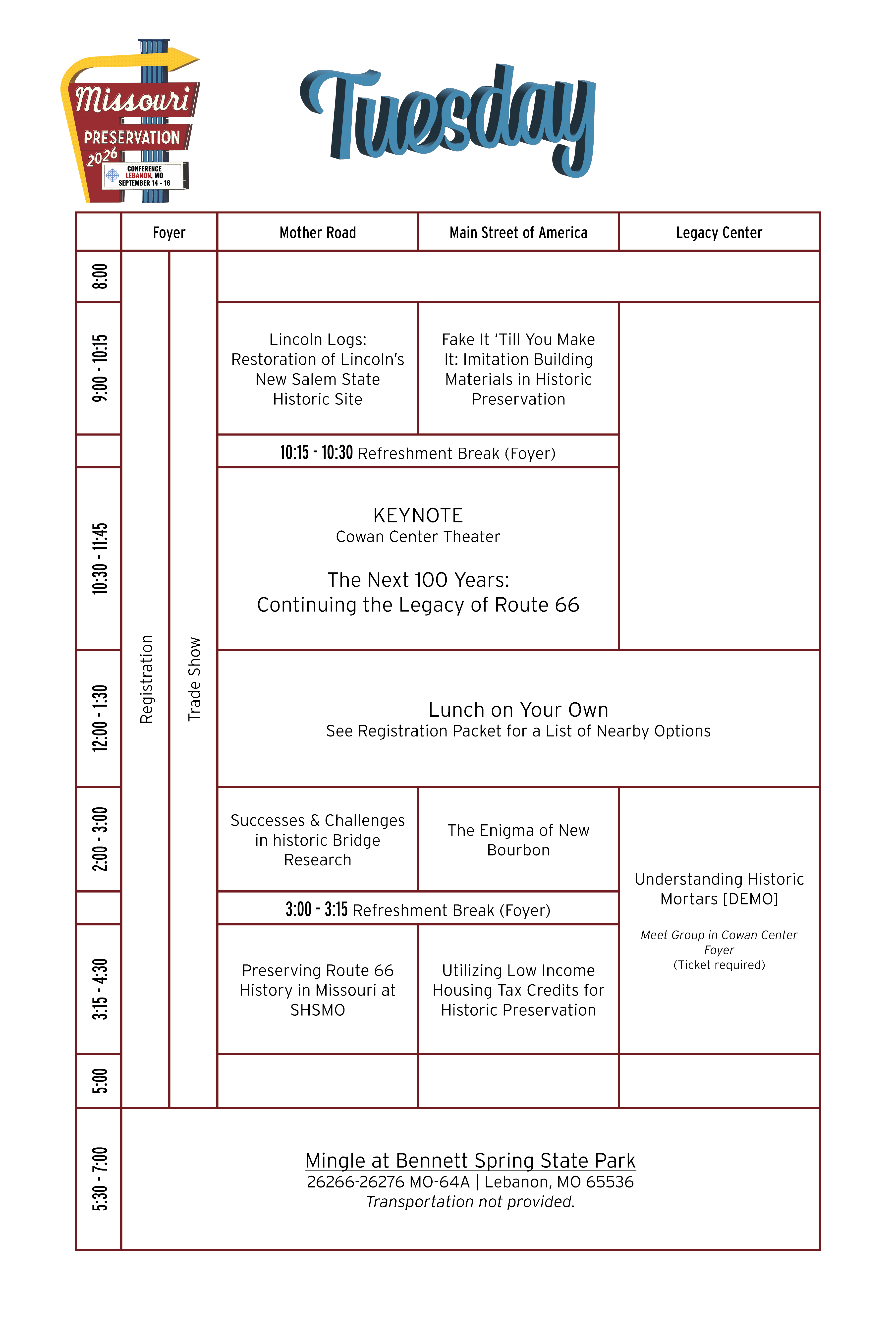
Tuesday, September 15th
Lincoln Logs: Restoration of Lincoln’s New Salem State Historic Site
9:00 – 10:15 a.m. | 1.25 AIA HSW
Lincoln’s New Salem State Historic Site is a reconstructed village where Abraham Lincoln spent 6 formative years of his early adulthood. Platted in 1829, the town existed for about 12 years before being abandoned and left to pasture. The centerpiece of Lincoln’s New Salem is the imaginative recreation of the log village. Rebuilt in the 1930s and 1940s as a Civilian Conservation Corps program, the village features historically furnished buildings, including several homes, stores, and tradesmen’s shops, as well as a tavern, school, wool carding mill, and a saw and gristmill rebuilt in original locations.
Restoration of the CCC-era timber construction aims to stabilize, repair, and restore 22 log cabins that have deteriorated due to wood rot, poor drainage, water penetration and saturation, insect/vermin infestation, and other deferred maintenance. The architectural team with historic expertise will share an in-depth process to evaluate, categorize, and establish scopes of work related to stone foundations, log floor, wall, and roof framing, stone and log chimney reconstruction, and wood shake and comb restoration. Restoration techniques covered in the study address the impacts of site and landscape, biological growth, log rot, decay, and protection, repair and replacement of a variety of log construction methods, and use of contemporary materials to minimize adverse effects on the nearly 100-year-old cabins.
Ross Welch, Senior Technical Director — Trivers
Amanda McAllister, Project Manager — Trivers
Joe Carpenter, Structural Engineer — KPFF
Fake It ‘Till You Make It: Imitation Building Materials in Historic Preservation
9:00 – 10:15 a.m. | 1.25 AIA HSW
Session Sponsored by Terra Nova Builds
Often overlooked or deemed non-historic, imitation building materials are a fundamental part of the American architectural landscape. As preservationists, we must grapple with the fact that in many cases, these “fake” materials are just as historic as materials such as marble, slate, and terra cotta.
This session will explore the history and usage of replacement/imitation building materials. It will include a discussion of the development of imitation materials at the turn of the twentieth century, such as cast concrete block, pressed metal, and linoleum, and discuss modern imitation building materials in an effort to reframe the discussion around these materials.
The session will also explore common replacement materials in historic rehabilitation situations such as historic tax credit projects, and provide information and solutions on appropriate treatments for historic building owners.
Mason Martel, Project Manager — Heritage Consulting Group
KEYNOTE – The Next 100 Years: Continuing the Legacy of Route 66
10:30 – 11:45 | 1 AIA LU
Keynote Sponsored by Lawrence Group
Successes & Challenges in Historic Bridge Research
2:00 – 3:00 p.m. | 1 AIA LU
This session will focus on how the Missouri Department of Transportation complies with Section 106 to receive federal funding for projects involving historic bridges. Out of 25,000+ bridges across the state, 3-5% are “historic” in that they have been determined eligible for or listed in the National Register of Historic Places. The session will cover the historic bridge identification process, bridge eligibility assessments, and programmatic agreements for certain types of bridges. Given that MoDOT’s work can and does lead to adverse effects on historic bridges due to demolition, removal from the original location, removal or alteration of original bridge parts, and introduction of new elements that diminish the bridge’s significant historic features, mitigation efforts are necessary to comply with Section 106. This session will detail the different mitigation efforts used when there is an adverse effect on a historic bridge, including the various levels of documentation, historic bridge research methods and sources, and MoDOT’s Free Bridges marketing campaigns. The session will also include two case studies of historic bridge documentation. One will explore a major river bridge, the 1953 St. Francis Bridge in Dunklin County that crosses the St. Francis River into Clay County, Arkansas, on U.S. 62, which is the only east-west highway that connects Mexico to Canada. The other case study will focus on two rural 1922 bridges built over Bee Creek in Buchanan County. The bridges relate to the Jefferson Highway, one of the early north-to-south cross-country routes. The presenters will discuss the successes and challenges of research for these bridges, compare the criteria used for determining their NHRP eligibility, and situate the bridges in state and national transportation history.
Rose Campbell, Intermediate Historic Preservatoin Specialist — Missouri Department of Transportation
Rose Campbell is a Historic Preservation Specialist at the Missouri Department of Transportation (MoDOT). Before her role at MoDOT, Rose organized public history programming, taught classes, and managed an oral history archive at Regis University in Denver, Colorado. She also worked at the History Colorado Center, the state’s history museum, in a variety of roles. She served as a Historian at a historic preservation consulting firm in Columbia, Missouri as well. Rose received her undergraduate degree in History from Regis University and a graduate degree in Public History from the University of Colorado-Denver where she was the recipient of the Ward Prize in Public History and a fellowship at the History Colorado Center.
Evelyn Carmack, Historic Preservation Specialist — Missouri Department of Transporation
Evelyn Carmack is a Historic Preservation Specialist at the Missouri Department of Transportation (MoDOT). Her focus is on architectural history and built environment and she works on Section 106 compliance and cultural resource surveys. Evelyn received her Bachelor of Science in Historic Preservation at Southeast Missouri State University. Following her undergraduate, she completed her Master’s in Public History: Historic Preservation at the same university. She also completed practicums in historic site management and archives. She completed two internships during her academic career, including one with Delaware State Parks at the great Auburn Valley State Park and another with MoDOT as a historic preservation intern focused on archaeology.
The Enigma of New Bourbon
2:00 – 3:00 p.m. | 1 AIA LU
The de Lassus-Kern House in New Bourbon, Missouri, is a lesson in how to read a historic property and appreciate and value a history that is not always clearly expressed. Uncovering the layers of this house revealed a rare French vertical log building that was undiscovered until the mid-1980s. This presentation documents the history of the property through primary resources, oral histories, and family photos; discusses the value of retaining and protecting a property as an artifact while developing a plan for its future use or interpretation; and provides an overview of scientific studies (dendrochronology and archaeology) and how they contributed to the historic context. At the end of the presentation, participants will be invited to consider how to interpret a property and what would be an appropriate period of significance and what material to remove to expose different historical construction eras.
Melissa Gengler, President/Architectural Historian — Historic Resources Group, Inc.
HRG is a federally certified woman owned small business enterprise (WOSB) located in Lincoln, Nebraska. Since its inception in May of 2010 HRG has been actively growing as a respected full-service cultural resource management and historic preservation company. HRG has extensive background in successfully completing complex Section 106 evaluations, historic tax credit applications, National Register nominations, developing historic contexts, and historic property survey and planning. As a team member for larger scale projects, HRG has participated in Historic Structures Reports, Cultural Landscape Reports, management plans, and agreement documents. HRG staff meets the Secretary of the Interior’s Standards Professional Qualifications in history and architectural history. Since the company was founded in 2010, HRG has built lasting partnerships with federal agencies, private consultants, architectural firms, engineering firms, and private and non-profit organizations. HRG values the sense of community and identity historic preservation provides and works diligently and in cooperation with designers, planners, and governments to preserve the vitality and unique identity each community expresses within their built environment as well as interpreting those design elements in new compatible construction. Melissa Dirr Gengler is the owner and President of HRG. Melissa has 35 years of experience in the field of historic preservation. She has spent extensive time conducting surveys and evaluations of historic resources across the Midwest Region. Prior to establishing HRG Melissa worked for the State Historic Preservation Offices in Nebraska and in South Dakota. Her professional background in both the public and private sector provides a broad base of knowledge and skills to identify, evaluate, and document historic properties and understand the needs of large and complex projects.
Preserving Route 66 History in Missouri at SHSMO
3:15 – 4:30 p.m. | 1.25 AIA LU
Session Sponsored by Patterhn Ives LLC
This will be a look at the work done by the State Historical Society of Missouri (SHSMO) to preserve the history of Route 66 in Missouri. Our preservation work includes preserving and providing access to photographs, postcards, maps, blueprints, newspapers, oral histories, film, advertisements, correspondence, and more. Learn how scholars, researchers, preservationists, and history enthusiasts can access the resources available at SHSMO. Highlights will include information on the Quinta Scott photograph collection and highlights of iconic Route 66 locations in Missouri through archival materials.
Kathleen Seale, Regional Director — State Historical Society of Missouri
Haley Frizzle-Green, Senior Archivist — State Historical Society of Missouri
AJ Medlock, Regional Director — State Historical Society of Missouri
Ashley Weaver, Archivist — State Historical Society of Missouri
Utilizing Low-Income Housing Tax Credits for Historic Preservation
3:15 – 4:30 p.m. | 1.25 AIA LU
Historic Tax Credits are only part of the funding stack when rehabilitating any historic building. HTCs are most often paired with Low Income Housing Tax Credits, especially when rehabilitating larger buildings. However, the process of qualifying for LIHTC is complex, and is not well known to many preservationists. In this session, a representative from the Missouri Housing Development Commission (MHDC) will discuss LIHTC’s role in repurposing existing buildings. Real estate developers with experience combining HTCs and LIHTC will explain the complexities and nuances involved in both federal and state LIHTC programs, and a preservation consultant will discuss projects in Missouri that have successfully combined these two funding streams.
Elizabeth Hornbeck, Section Chief, Architectural Preservation Services — State Historic Preservation Office
Elizabeth Hornbeck is an SOI-qualified architectural historian, and she is section chief of the Architectural Preservation Services (APS) section at SHPO. She holds a PhD in the History of Architecture from the University of California, Santa Barbara, and she taught architectural history at the University of Missouri in Columbia for 18 years before joining SHPO in February 2023.
Deb Sheals, Preservation Consultant — Building Preservation LLC
Deb Sheals owns Building Preservation LLC in Columbia, Missouri. She is an architectural historian with 30 years of experience in historic preservation, including Historic Tax Credits, Historic Structure Reports, and the National Register of Historic Places. She has been involved with other 200 historic tax credit projects in six states.
Dan Sanders, Executive Vice President — MACO Development Company
DEMO: Understanding Historic Mortars [pre-registration required]
2:00 – 4:30 p.m.
This demonstration will cover the history of mortar composition in the US and England in the 19th century. Participants will learn about the lime cycle, common aggregates and additives, and the distinction between hydraulic and carbonizing mortars. Participants will also watch a live demonstration on mixing different mortars, lime washes, and plasters, learn about the benefits of using historically appropriate mortars, and where to source materials for recreating them.
Mitch Goist, Owner — Acanthus Restoration
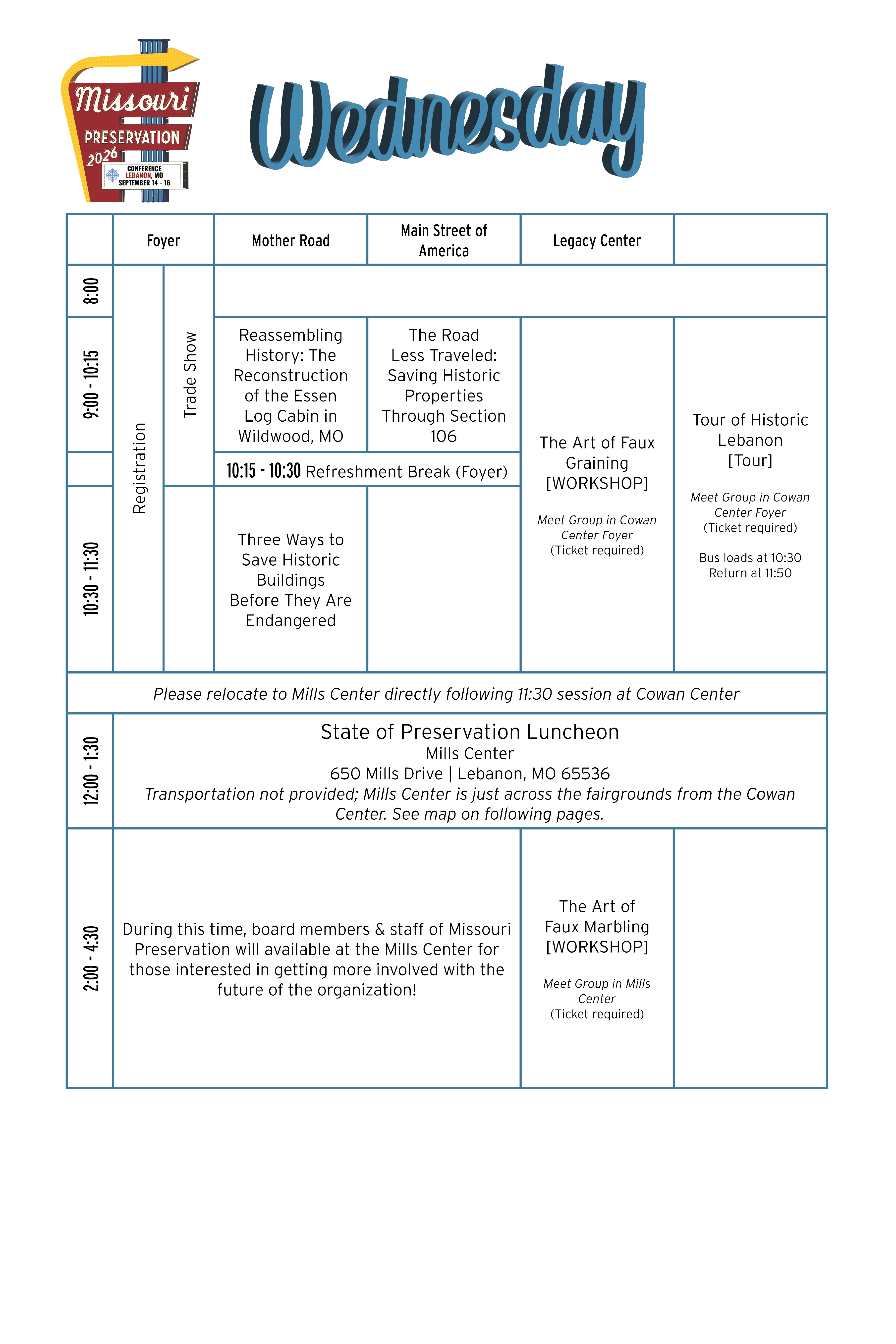
Wednesday, September 16th
Reassembling History: The Reconstruction of the Essen Log Cabin in Wildwood, Missouri
9:00 – 10:15 a.m. | 1.25 AIA HSW
Session Sponsored by STRATA Architecture + Preservation
The reconstruction of the historic Essen Log Cabin in Wildwood, Missouri represents a unique preservation effort involving forensic reconstruction, historic material conservation, and preservation-focused design. Originally constructed circa 1878 by the Essen family, the cabin was donated to the City of Wildwood in 2015, but was illegally dismantled and stolen before relocation efforts could begin. Although the logs were recovered, the unauthorized disassembly created significant reconstruction challenges because the structure had not been documented prior to removal. This panel session will examine the process of reconstructing the cabin from recovered materials, including the 2019 log-tagging effort, development of reconstruction drawings, preservation decision-making, and implementation of historically appropriate materials and methods. Presenters will discuss balancing accessibility, applicable code requirements, and municipal budget and long-term maintenance considerations, while maintaining the cabin’s historic integrity and rustic character. The session will also explore the City’s decision to place the disassembled cabin on the Wildwood Historic Register prior to reconstruction, allowing the project to utilize historic building code provisions and avoid unnecessary modern systems inconsistent with the structure’s historic appearance and use. Attendees will gain practical insight into preservation problem-solving, reconstruction of historic structures following undocumented disassembly, and the role local governments and preservation professionals can play in preserving community heritage resources.
Robyn Keefe, AICP, Planner – Historic Preservation — City of Wildwood, Missouri
robyn@cityofwildwood.com
Robyn C. Keefe, AICP, is a planner with the City of Wildwood and staff liaison to the Historic Preservation Commission, where she manages a variety of preservation and heritage initiatives, including the Essen Log Cabin Reconstruction Project, Route 66 revitalization efforts, and the Citywide Historic Preservation Plan. With more than 15 years of experience in planning, community engagement, and collaborative project leadership, she has worked on local, regional, and statewide initiatives involving historic preservation, heritage tourism, youth engagement and empowerment, and community development. Robyn holds a Master of Regional Planning degree from the University at Albany–SUNY and is a certified member of the American Institute of Certified Planners (AICP).
Steve Scott, AIA, NCARB, Advisor — Wildwood Historic Preservation Commission
stevescott.wildwood@gmail.com
G. Stephen Scott, AIA, NCARB, is a registered architect in Missouri and five additional states. His professional work includes numerous historic restorations and adaptive reuse projects throughout St. Louis and St. Charles County, including the NGA’s St. Louis Arsenal, Laclede’s Landing, and the Arsenal Street Poor House. He previously served two three-year terms on the Wildwood Historic Preservation Commission and currently serves as architectural advisor to the commission. He is also a member of the Wildwood Historical Society.
Carol Jean Quigley, Senior Designer/Project Manager — Frens & Frens Studio of Patterhn-Ives
cquigley@patterhn-ives.com
Carol Jean Quigley has worked with Frens & Frens Studio of Patterhn-Ives for 26 years as studio director, project manager, senior designer, and historic preservation specialist. The Frens & Frens Studio practice has focused on restoration, rehabilitation, and preservation of historic structures in the Mid-Atlantic region for nearly 40 years and the Saint Louis region for over ten. A graduate of the University of Notre Dame and its Rome Studies Program, Ms. Quigley’s professional experience has focused on historic styles and historic structures throughout her entire career. A core tenet of the Studio is the belief that the benefits of revitalizing a historic structure through sensitive preservation extend well beyond the building and owner; in some instances, entire communities are positively impacted.
Elias McDonald, Vice President, Reconstruction Contractor — Charrette Creek Excavating
emcdonald@digccx.com
Elias McDonald, MBA, Vice President of CCX, holds a B.A. in History from the University of Missouri–Columbia and led CCX’s restoration of the Essen Log Cabin. He brings extensive experience in historic restoration, reflected in the successful preservation of the Essen Cabin.
The Road Less Traveled: Saving Historic Properties Through Section 106
9:00 – 10:15 a.m. | 1.25 AIA LU
This session will look at the Missouri Department of Transportation’s (MoDOT) project to improve a section of I-64 east in St. Louis and how historic properties were avoided as part of the Section 106 (NHPA) and Section 4(f) (DOT Act) processes. This session will also explore the history of Mill Creek Valley in St. Louis, continued efforts throughout the community to acknowledge that history, and reckoning with the legacy of urban renewal as a current DOT Historic Preservation Professional.
Jordan Cuneio, Intermediate Historic Preservation Specialist — Missouri Department of Transportation
jordan.cuneio@modot.mo.gov
Jordan Cuneio graduated from Southeast Missouri State University with her Bachelor of Art in History and her Bachelor of Science in Historic Preservation during the height of the Covid 19 Pandemic. Since then, she has been a seasonal interpreter at Missouri State Parks and is now working at the Missouri Department of Transportation as an Intermediate Historic Preservation Specialist. She is an architectural historian, researching and assessing all aspects of the built environment, not just buildings, under Section 106 of the NHPA. Jordan’s favorite architectural style is Tudor Revival, but she’s recently discovered a soft spot for Brutalism.
TOUR: Tour of Historic Lebanon [pre-registration required]
9:00 – 11:30 a.m.
Tour Sponsored by Mangrove
See and hear about historic sites in and around our host city of Lebanon! Stops include Manor Inn on Rte 66 (former Lenz Tourist home), Boswell Park and the restored Camp Joy cabin, and the Benton Stagecoach Stop!
WORKSHOP: The Art of Faux Graining [pre-registration required]
9:00 – 11:30 a.m.
Faux bois, or decorative painting techniques that transform ordinary surfaces into exotic woods, was a hallmark of Victorian interior decorators. Join a master painter as he demonstrates techniques to recreate these historic finishes. Participants will learn how to draw and distinguish different woodgrains, and reproduce finishes using modern and historic techniques.
Bob McCarty
Three Ways to Save Historic Buildings Before They Are Endangered
10:30 – 11:30 a.m.
Session Sponsored by City Restoration & Revival LLC
Preservationists often try to save properties only after they become endangered. This presentation will teach attendees three ways to set up infrastructure to save historic buildings, namely: Historic Tax Credits, Local Historic Designations, and Easements. SHPO staff will walk attendees through these methods.
Christopher Stone, Certified Local Government Coordinator — State Historic Preservation Office
christoper.stone@dnr.mo.gov
Christopher Stone is a graduate of Liberty University where he received his BS in History. He spent several years in North Carolina running his own hands-on historic preservation business before moving to the government side of preservation, working as a historic tax credit reviewer for both the Missouri and North Carolina SHPOs. Christopher currently lives in Jefferson City, MO and works as the Certified Local Government Coordinator for the Missouri SHPO.
Andrew Dial, Community Services Section Chief — State Historic Preservation Office
andrew.dial@dnr.mo.gov
Andrew Dial is the Community Services Section Chief at the Missouri State Historic Preservation Office. His responsibilities include Certified Local Governments, Historic Preservation Fund grants, historic preservation easements, and Missouri’s statewide preservation plan. He holds a PhD in History from McGill University.
WORKSHOP: The Art of Faux Marbling [pre-registration required]
2:00 – 4:30 p.m.
Throughout history, marble has had a reputation as one of the finest building materials in the natural world. So it comes as no surprise that an entire art form grew amongst painters in mimicking this intricate and fascinating material. Join a master painter as he demonstrates techniques to recreate these historic finishes. Participants will learn how to draw and distinguish different types of marble, their grains and coloring, and reproduce these finishes using modern and historic techniques.
Bob McCarty

Missouri Preservation is proud to be a continuing education provider for the American Institute of Architects.